
The two sites are leading in digital marketing, but they have varying functions, target different classes of purchasers, and work on different user inspirations. Amazon attracts buyers who are already willing to spend, a trait that makes it a marketplace with high intent and, therefore, a good fit for product-oriented sellers.
Google Ads, on the other hand, provides brands with access to billions of daily searches of informational, commercial, and transactional queries. It establishes a bigger platform of discovery, generation of demand, and remarketing. The comparison between the two platforms in terms of performance can only be understood by getting down to the behavior of users, types of ads, types of costs and level of competition, and sales cycles.
The Core Difference:
The main difference between Amazon Advertising and Google Ads is the user intent. Amazon attracts customers who are already in search of goods with the aim of making purchases. This turns Amazon into a bottom-of-funnel force in which advertisements directly coincide with the act of making a purchase. In contrast, Google Ads cuts across the customer lifetime. Users do not only search for products, but may search for answers, reviews, comparisons, or solutions. This makes Google a discovery engine and a conversion engine.
In the case of sellers, Amazon will boost direct sales, whereas Google will promote wider goals, including brand recognition, web traffic, and the generation of leads. The two platforms are not better or worse than each other; however, they serve divergent marketing purposes. Commodity products or sellers who are targeting impulse buyers are usually more likely to achieve increased turnover on Amazon. On the other hand, companies providing more complicated or costlier products prefer to build curiosity by using Google and then redirecting the consumer to buy.
Amazon Advertising: How it works:
Amazon Advertising is designed to specifically match the needs of product-focused companies that desire to gain visibility in the Amazon giant market. Its advertisement types, which are Sponsored Products, Sponsored Brands, and Sponsored display, allow sellers to feature on the search results pages, the product pages, as well as the recommendation section. Through this structure, the advertisers can be able to promote certain SKUs, protect brand positioning, and expand share-of-voice relative to the competition.
Since Amazon customers are in the buying decision phase, conversion to sales takes a short duration, providing the advertiser with performance metrics that are practical and instant. The algorithm used by Amazon to determine ads that generate sales is more effective than placing ads based on their historical data and relevance.
Google Ads is a multi-channel, multi-intent Advertising Ecosystem
Google Ads is the world’s largest Search, Display, Shopping, YouTube, and Discovery campaigns. Though Amazon is exclusively involved in eCommerce operations, Google presents the brands to the audience in informational, commercial, and purchase-intensive spaces. Search advertisements focus on keywords in billions of queries all over the world, and this makes Google the right candidate to capture the demand at different buying cycle levels.
Shopping advertisements show product images and prices in the form of direct in-search results, which enables sellers to find individuals who have already started comparing products. In the meantime, YouTube and Display ads contribute to familiarity and influence choices prior to active shopping on the part of the users. The strength of Google is the ability to target widely that including location, interests, behavior, demographics, and custom audience.
Cost Comparison: Which platform is cheaper to sell on?
Cost efficiency is very diverse since both platforms are based on auction pricing. Amazon can be initially costlier, especially in a competitive niche like home goods, electronics, and beauty. The reason is that the sellers are competing head-on against product-oriented keywords, with most of them being highly commercial in nature. Total height leads to a height of competition, and this translates to high CPCs.
Nevertheless, Amazon tends to have higher conversion rates that offset the advertising cost of sales (ACoS). Google Ads, on the other hand, is between low and high cost based on the category of keywords. Informational keywords are not expensive, whereas commercial keywords, such as the buy laptop online can be costly.
Why Amazon Can Be Flexible in Sales, and Often Beat Google
Amazon conversion rates are usually higher than those of Google since Amazon is programmed to make purchases. Users come with the intention of buying, making comparisons, and reviews, and study the delivery times. All the components of the platform aid the product assessment and the sale. The frictionless checkout process of Amazon, along with the belief in the quick delivery guaranteed by Prime, contributes to increased confidence in the user, which, in turn, stimulates fast purchases.
To the sellers, this provides an environment where advertisements are effective, particularly on highly rated, competitively priced products. The quality of landing pages, the reputation of the brand, and the stage of the user journey determine the Google Ads conversions. Google Shopping advertising can be very successful, but it still assumes that the user has to go out of Google and to a site or a marketplace.
Differences in Audience Targeting that affect Seller Effects
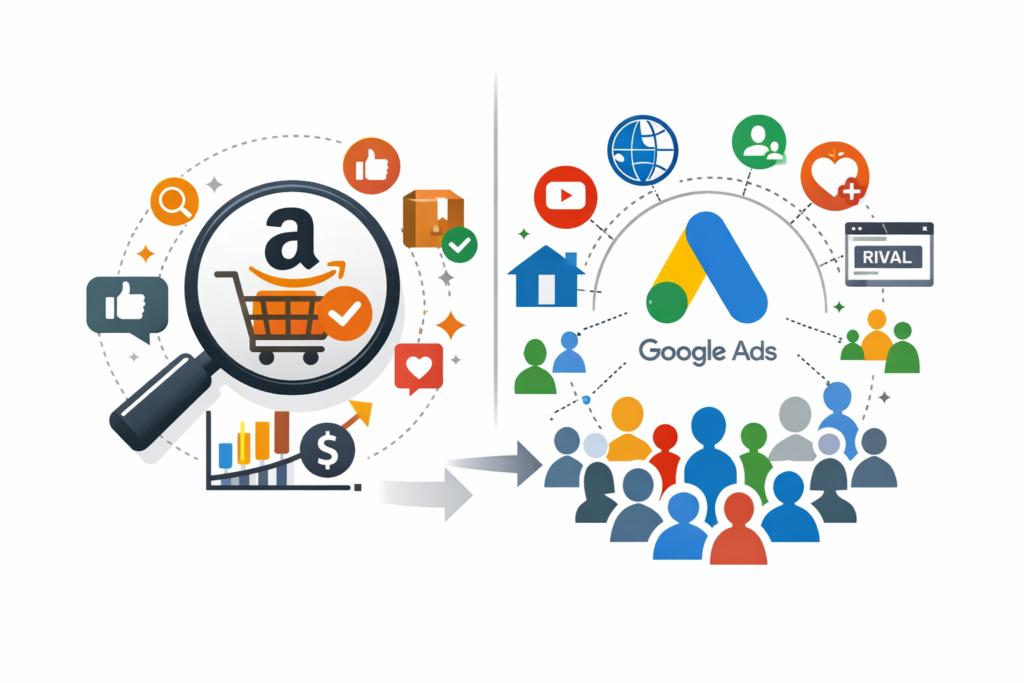
The targeted model developed by Amazon is based on the behavior of the shoppers, such as the things a user searches, likes, buys, or places in their cart. This also provides advertisers with accurate information on purchase behavior, as well as the ability to target ads at the product-level interest. Nevertheless, the targeting is usually restricted to shopping data.
The targeting ecosystem of Google Ads is much larger. Sellers have the opportunity to access users according to age, interest, online activity, life experience, past searches, video viewing, and even searching rival websites. This puts Google in a better position to sellers who want to create more awareness or reach new audiences who are yet to prove their buying intention.
Which is Superior in Creative Control?
Amazon offers a small but very useful range of advertisement types that are meant to promote the products. These are Sponsored Products, Sponsored Brands, Sponsored Display, and video. They are simple and advantageous to sellers who seek a straightforward route to sales but not creative storytelling. Google Ads, in its turn, has a greater arsenal of creativity:
- Intent-based text targeting search advertisements.
- Advertisements of the products in terms of price and image.
- Video advertisements on YouTube are used to tell visual stories.
- Advertise on millions of partner sites.
- Discovery promotions of lifestyle-based positioning.
Such a combination gives brands the chance to be personality, open-minded, and persuade decisions long before a buyer clicks on Buy Now.
Brand-Building vs. Sales-Driving
Amazon Advertising has a primary interest in sales-oriented activities. It assists sellers in raising the product exposure, making a quick conversion, and higher ranking. Since users visit Amazon with a purpose to make a purchase as opposed to going there to window shop, the environment constrains the ability to tell a brand story in the long term.
Google Ads, conversely, helps to build brands on a large scale. The sellers have the ability to narrate brand stories using YouTube, intent-driven traffic using Search, and maintaining presence across websites and applications using Display. This multi-channel context makes the recall strong, builds trust and fosters users through long purchase cycles.
Which Data and analytics Platform provides better Data to Sellers?
The analytics of Amazon are based on the performance of the product: the ranking of the key words, ACoS, the conversion rate, and attributed sales. These observations will assist the sellers in knowing which products perform and which words yield a lucrative demand. Nevertheless, Amazon does not give much insight into how its users behave beyond the shopping process.
Google Ads provides much more detailed analytics with Google Analytics, Search Console, as well as information platform-specific. The sellers are able to examine their user journeys, session behavior, bounce rates, funneling stages, demographic segments, device performance, and attribution models. This puts more insight into the reason why one converted or not.
Conclusion:
The decision of Amazon Advertising or Google Ads hinges wholly on your objectives, audience, product type, and long-term strategy. Amazon cannot be compared to others when you need to make fast and high-intent sales. It has an audience that comes with an intention to purchase, which enables the sellers to turn traffic effectively and command size in the market. Nonetheless, this is also the strength of Amazon, which is its limitation: you are dependent on platform regulations, competition, and fee mechanisms.
