
Google in 2025 has never laid more focus on these aspects, as there is an increased amount of misinformation and the necessity to focus on user safety and accuracy.
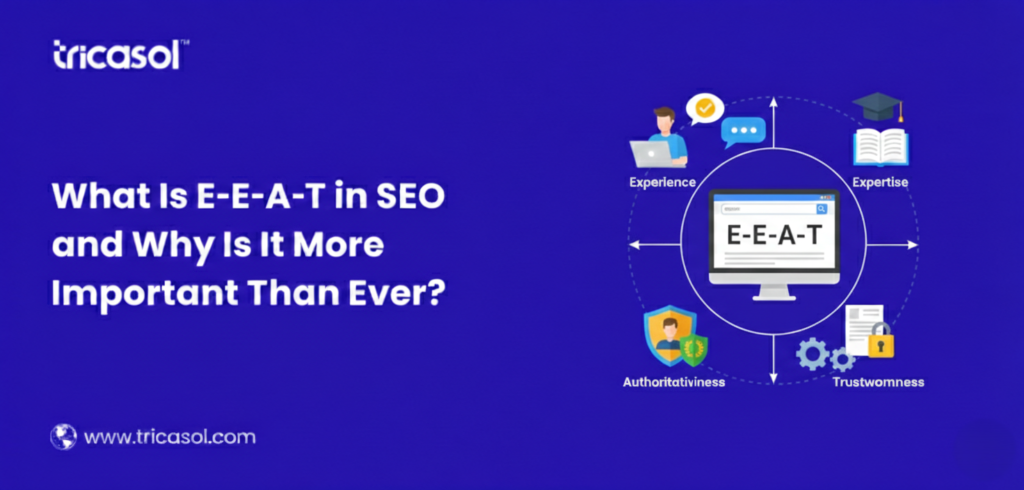
Living in the constantly changing world of SEO, it is crucial to learn the quality criteria of Google, and E-E-A-T has become the most important in the modern world: Experience, Expertise, Authoritativeness, and Trustworthiness a set of criteria according to which Google can assess the quality and reliability of the information, particularly when the subject of the question is one of the high stakes, such as health and money.
Sites that are better at showing E-E-A-T are more visible, trusted, and interacted with by the users, indicating to Google that they are good content that should be given priority in ranking. To any search seeker, E-E-A-T should be mastered to ensure that one can develop content that not only informs but will develop authentic credibility, which is unique in a crowded online environment. This full reference manual will answer the following questions: what each E-E-A-T element represents, why it is more important than ever before, and how you can optimize your area to achieve the same.
Experience: Demonstrating working Knowledge
The new E-E-A-T model of Google incorporates experience as its initial new E. It implies that there should be authentic firsthand experience in the subject matter. This is something that gives sincerity and exclusivity to users and search engines. Regardless of whether you are writing about a product review, health tips, or a financial tip, showing personal or professional experience will make your content more credible.
As an example, a travel blogger who tells about his or her trip or a doctor who tells about treatments that have been proven during many years of experience is an example of action. This aspect gives readers the confidence that advice is not an idealistic concept. Google favors content in which experience is the name of the game since it is not only informative but also useful. This can be done by ensuring that your content articulates your real life to a great degree, and this potential quality and ranking can increase the perceived quality of your content dramatically.
Expertise: The Powerhouse of Quality Material
Expertise extends experience to encompass formal knowledge, skills, credentials, or professional qualifications. It is an indispensable attribute in issues in which a specialized type of expertise is vital, like medical, legal, or financial consultations. Google searches on content prepared or analyzed by professionals who are well-versed in the topic. This is an indication of trustworthiness and curbs the chances of misinformation.
Blogs, articles, or videos containing certified professionals who have received industry credentials or certification can be used to meet this requirement. In some fields, the casual advice can be of help, but Your Money or Your Life (YMYL) is also high-level knowledge that requires the use of high-quality standards offered by Google. Showing expertise in an obvious way, in the form of author bios, citations, and credentials, improves trust and SEO performance.
Authoritativeness: Becoming an Authoritative Leader
Authoritativeness is a concept that determines the extent to which your site or content is considered a resource to visit in its niche. It will rely on your reputation, good backlinks, positive mentions, and the perception of others in your industry. Authoritativeness is achieved with time and with a great deal of valuable content, and by adding value in your community or industry.
As an example, when other respectable sites mention your site or give recommendations, the credibility of your site rises. Google algorithms attach importance to the content of authoritative sources since it probably gives correct and exhaustive information. Authoritativeness can be developed through participating in guest posts, collaborations, publishing whitepapers, and being an active participant to appropriate forums or conferences. This is the feature that assists search engines in discriminating between the really credible and less credible sites.
Trustworthiness: The Keystone to User Confidence.
The most essential aspect of E-E-A-T is probably trustworthiness. It is about assuring the user and search engines that your contents are sincere, secure, and trustworthy. Factors that promote trust are contact information, privacy policies, secure websites, and open-source software. The trust is also developed by the user reviews, testimonials, and ethical approach to content creation.
The raters of Google determine whether the content contains misleading or deceptive information and whether the content is respectful to the privacy and data of the users. The lack of trust will not display even professional content in search results since users will not be willing to go back and use it. It should focus on transparency, accuracy, and user-centric practices to build a trusting brand and achieve greater rankings.
The Importance of E-E-A-T in 2025 More Than Ever
The current digital world is flooded with content of all grades, and it is more difficult than ever to find credible information on the internet. The level of attention to E-E-A-T that Google paid is a response to the need to provide reliable results in the environment of this noise. The emergence of AI-created content, fake news, and fraud are forcing strict quality checks to safeguard the consumers.
Besides, the E-E-A-T is considered to be a necessity in industries like health, finance and safety where the consequences of bad advice are very real in the real world. Sites that fail to observe these principles are in danger of being punished or covered with superior content. On the other hand, engaging in E-E-A-T content planning implies keeping pace with Google, increasing the search-result ranking, customer confidence, and developing in the long term.
How to One-Optimize Your Content to E-E-A-T
Enhancing your E-E-A-T of your site is not an accident. Begin by presenting your experience in terms of original storytelling and original ideas. Authorize expertise by providing an author bio with credentials and connecting with reputable sources. Establish credibility and authoritative links, mentions, and alliances in your niche.
Lastly, build credibility through open policies, safe websites, and valid and verifiable information. Periodical checks of the content quality, as well as user comments, will keep and improve your E-E-A-T scores. It is important to remember that E-E-A-T optimization is a continuous procedure, which needs to be repeated, full of integrity, and the desire to give value first and foremost.
The Assessment of E-E-A-T Signals at Google
Google does not possess an E-E-A-T score, which directly influences rankings. Rather, the algorithm takes hundreds of signals that are used together to point to content quality. Search Quality Raters are actual men and women who rate the quality of search results according to E-E-A-T rules to check whether the Google lgorithm of Google is functioning properly. Their comments are used to improve the system in the long run.
The algorithm considers a variety of variables: author bylines that qualify the author, author biographies that prove his expertise, external legitimacy in the form of backlinks on credible websites, references to the brand or author on the web, the depth and accuracy of the content, positive user interaction rates, and technical security tools. Moreover, Google investigates the reputation of the site based on the reviews, news, and mentions in reputable websites, such as Wikipedia or professional directories.
Common Mistakes to Avoid
- Publication of content without the name of an author or source of the information in the text – this kills credibility.
- The use of too many keywords to the extent of losing the actual value (thin, generic content).
- Relying on stock or superficial experience assertions (i.e., I once used X but not deeply) -this is not always enough to say that you used something.
- Thou not to consider link-building or external mentioning – in case you have no mentions, your authority is low.
- Taking the technical aspect of SEO, but not taking into account content credibility -E-E-A-T is more of people than it is of algorithms.
- Lack of updating the outdated content- old or wrong information destroys trust.
Conclusion:
E-E-A-T is not a luxury anymore; it is the backbone of successful SEO in the present time. The plea to experience, knowledge, authority, and credibility will not only get your content to rank highly, but it will also gain the trust and loyalty of your audience. By appearing in the quality guidelines of Google, you secure your online presence in the future against changes in the algorithms and market changes. Today, the best way to succeed in a competitive digital ecosystem in 2025 and beyond is to invest in E-E-A-T.
